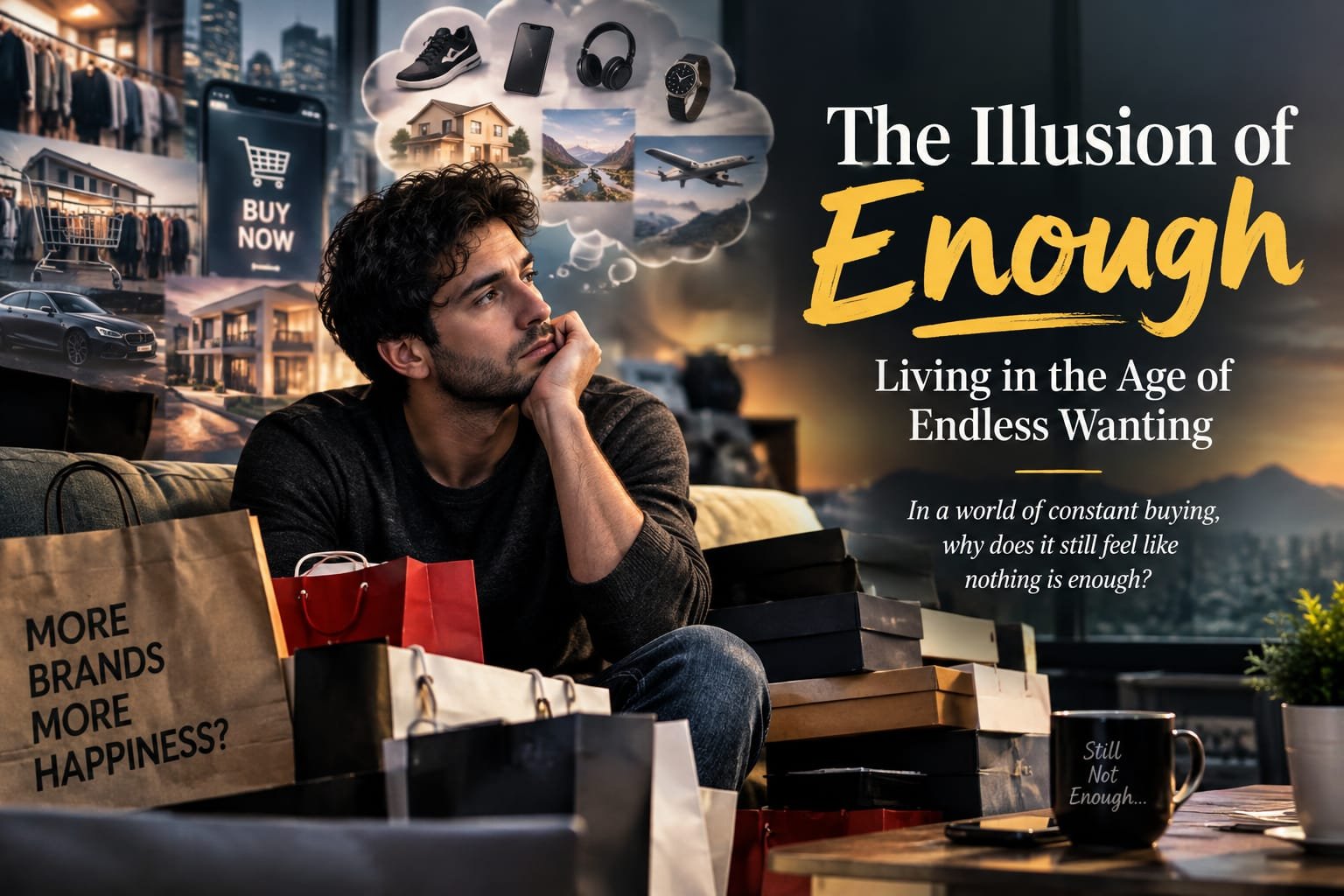
In a world of constant buying, why does it still feel like nothing is enough?
Inabat Nissar Zargar
Consumerism is no longer just about buying what we need. It has slowly become a way of living, a way of thinking, and sometimes even a way of measuring ourselves. What we own can feel connected to who we are. Somewhere along the way, the idea of “enough” has become harder to define.
The strange thing about wanting is that we often believe getting what we want will finally make us feel satisfied. But then we get it, enjoy it for a while, and soon there is something else we want. The finish line keeps moving.
I have noticed this in my own life. I might already have five perfumes, but after watching one good review or seeing someone talk about a new one online, suddenly I want it. I don’t necessarily need it. Sometimes I don’t even particularly like the fragrance. But for a few minutes, it feels like I am missing something. The funny part is that I was completely fine with the five perfumes I already had five minutes earlier.
Nothing about my life had changed. I had simply become aware of something I didn’t have. And that feeling of not having enough influences more of our decisions than we probably realise.
We live in a time when we are constantly exposed to what other people have. Someone gets a new phone. Someone buys expensive skincare. Someone has a wardrobe full of clothes they seem to wear only once. Someone is travelling, decorating their room, changing their car, or trying the newest product everyone is talking about.
After seeing enough of this, it becomes easy to look at our own lives and think we are somehow behind.
This is where comparison changes the meaning of “enough.” Enough stops being something we decide for ourselves and starts being measured against someone else. If another person has something newer, more expensive, or simply more popular, what we already have can suddenly feel inadequate.
What was enough yesterday can feel insufficient today.
And this isn’t only about money. It can affect how we feel about ourselves. Constant comparison can leave people feeling anxious, left out, or dissatisfied with their own lives. Some people spend money they don’t really have because they feel pressure to keep up. Others may not even buy anything, but still feel bad because they believe everyone else is doing better.
In that sense, consumerism sells us more than products. It can also sell us the feeling that we are somehow not enough.
Social media has made this much harder to escape. We see carefully selected versions of other people’s lives again and again. We know, logically, that people don’t post every boring, difficult, or ordinary part of their day. But knowing that doesn’t always stop us from comparing.
Then comes the shopping.
Shopping can sometimes feel like a quick way to make ourselves feel better. We are bored, stressed, upset, or simply having a bad day, and buying something gives us something to look forward to. The package arrives, we open it, and for a little while we feel good.
But the feeling doesn’t always last.
Maybe that’s because we aren’t really buying the object. We are buying what we imagine the object will make us feel. More attractive. More successful. More interesting. More put together. Maybe even more complete.
‘We don’t just buy things; we buy the feeling of becoming someone better’.
Technology has made this cycle even easier. We no longer have to leave our homes to shop. We can see something on Instagram, click a link, pay for it, and have it delivered to our door. Sales, discounts, limited editions and countdowns make the whole process feel urgent.
“Buy now.”
“Only a few left.”
“Sale ends tonight.”
Sometimes we know these messages are designed to make us act quickly, and we still fall for them.
FOMO, or the fear of missing out, plays a big role here. We worry that if we don’t buy something now, we will regret it later. Technology has given us more choices than ever, but somehow all those choices can also make it harder to figure out what we actually want.
Stress and boredom add to the cycle. When we feel overwhelmed, buying something new can become a small escape. It gives us a distraction. But once the excitement disappears, whatever was bothering us is usually still there.
That makes me wonder whether sometimes we are using consumption to avoid asking a more uncomfortable question: what are we actually looking for?
I once came across a talk by Jiang Xueqin in which he described consumerism as a kind of modern “perfect slavery.” The phrase sounds extreme at first. After all, nobody is physically forcing us to shop. But the idea is interesting because we can sometimes feel compelled to keep buying even when we already have more than enough.
There is always a new phone, a new collection, a new skincare product, a new version of something we already own. The cycle doesn’t really need to end because there is always another thing to want.
At the same time, there is another side to this conversation. In a free market, companies respond to what people buy. If consumers stop buying a product, businesses have a reason to change or stop selling it. We do have choices. No one is standing over us and forcing us to click “buy now.”
But how independent are those choices when our desires are constantly being shaped?
We see advertisements all day. We watch influencers recommend products. We hear our friends talk about things. Algorithms learn what catches our attention and then show us more of it.
Eventually, something can feel like our own desire simply because we have seen it so many times.
That doesn’t mean we have no freedom. It means that freedom is more complicated than simply having choices.
Maybe being free isn’t only about being able to choose between hundreds of things. Maybe it also means being able to stop and ask why we want those things in the first place.
This is where consumerism becomes more than an economic issue. It becomes a philosophical one.
Aldous Huxley explored a similar concern in his writing: the possibility of people becoming so distracted by pleasure and entertainment that they stop questioning the world around them. The context is obviously different, but the question still feels relevant.
When we are constantly thinking about what to buy next, what to watch next, or what to upgrade next, we may not stop to ask why we are doing any of it.
Consumerism also changes the way we interact with other people. Conversations can easily become about what we bought, what we want to buy, what is trending, or what someone else has. None of these things are necessarily bad. There is nothing wrong with enjoying nice things or talking about them.
The problem begins when our sense of worth becomes tied to them.
If we constantly feel like we are behind, it becomes difficult to feel satisfied with our own lives. We start looking outward all the time, checking what other people have and what we should have next.
And in doing that, we can lose something quieter.
The ability to simply be.
We are so used to improving, upgrading and adding that doing nothing can start to feel unproductive. There is always something to scroll through, something to buy, something to fix, something to become.
Sometimes I wonder if we have become so used to wanting that not wanting anything feels strange.
There is also the question of how many things we buy that we don’t really need. A product becomes popular because it is viral. A limited edition makes an ordinary object feel rare. A particular design becomes trendy, and suddenly everyone wants it.
A few months later, something else takes its place.
The product wasn’t necessarily bad. It just wasn’t as important as we thought it was.
And the cycle continues because there will always be something newer, faster, prettier or more desirable.
Globalisation has made products available to more people and has connected markets across the world. It has also made constant consumption easier. Economic growth and increased consumption are often treated as signs of progress, but buying more does not automatically mean living better.
So what do we do about it?
I don’t think the answer is to stop buying things completely. That isn’t realistic, and it isn’t necessary. We need things. We can also enjoy beautiful clothes, good food, technology, skincare, books, perfumes or whatever else brings us happiness.
The point is not to reject material things.
It is to become more aware of our relationship with them.
Before buying something, we can simply pause and ask ourselves: Do I actually need this, or do I just want the feeling it promises?
Sometimes the answer will be that we genuinely want it. And that’s okay.
But sometimes we might realise that we only want it because we saw someone else with it, because it is trending, or because we had a bad day and wanted a small reward.
That pause matters.
Practising underconsumption can also help. It doesn’t have to mean living an extremely minimal life or refusing ourselves everything. It can simply mean using what we already have, buying things when we actually need them, and not treating every new trend as something we have to participate in.
We also need to become better at questioning what we see online.
Not everything that is advertised is necessary. Not everything that goes viral is worth buying. And not everything someone else has needs to become something we want.
Perhaps the deeper problem with consumerism isn’t that we have too much.
Maybe it is that we have forgotten how to feel like we have enough.
There will always be another product. Another trend. Another upgrade. Another version of ourselves that we are told we could become.
If we keep feeding desire, there is no obvious point at which it naturally says, “That’s enough.”
So maybe the question isn’t simply what we want.
Maybe we should ask why we want it.
Is it something we genuinely value? Or is it something we have slowly been taught to desire?
Consumerism is not going away. And neither are advertisements, trends, shopping apps or the temptation to buy something just because it looks good.
But we can become a little more aware of the choices we make.
We can buy things without letting them define us. We can enjoy what we have without constantly comparing it to what someone else has. And sometimes, we can simply decide that we don’t need the next thing.
Because maybe freedom isn’t having the ability to buy everything we want.
Maybe freedom is being able to want less.
And maybe a meaningful life isn’t built by constantly adding more to it, but by learning what we can leave out.
Because the real question is not how much we can buy, but how much we can stop needing.