Dr. Faranaaz rasool
From academic reform and agricultural innovation to rural transformation, unprecedented student diversity, and global engagement, SKUAST-Kashmir’s journey illustrates how a public university can become a catalyst for societal change.
For decades, a persistent criticism of universities worldwide has been that they often remain distant from the communities they are meant to serve. Research papers are published, degrees are awarded, and laboratories produce new knowledge, yet translating these achievements into tangible improvements in people’s lives can remain limited.
In Jammu and Kashmir, where agriculture and allied sectors sustain a substantial rural population, this challenge is especially significant. Farmers need more than new technologies; they need practical solutions, stronger market linkages, and opportunities to improve their incomes. Young people need more than degrees; they need relevant skills, avenues for entrepreneurship, and access to emerging opportunities.
Over the past five years, Sher-e-Kashmir University of Agricultural Sciences and Technology of Kashmir (SKUAST-K) has increasingly sought to bridge this gap. Its institutional journey reflects a broader shift in the purpose of a public university—from a primary focus on teaching and research to a role as a catalyst for innovation, public policy, rural transformation, and economic development.
From academic tradition to an innovation-driven university
Institutional transformation begins when an organization re-examines its purpose. At SKUAST-K, a significant part of this process has involved expanding the traditional boundaries of agricultural education and research.
Innovation and entrepreneurship have taken a more central place in the university’s institutional mandate, alongside education, research and extension. The introduction of the SKUAST-K Innovation and Startup Policy (SISP) has provided a framework to encourage students and faculty members to translate ideas and research into products, technologies and entrepreneurial ventures.
This marks an important shift in institutional culture. Innovation is no longer seen merely as an occasional outcome of research; it is increasingly treated as a capability the university must deliberately cultivate.
The results are evident in a growing portfolio of intellectual property and student entrepreneurship. The university has reported more than 140 intellectual property rights and over 115 student startups. These developments are part of a broader effort to connect scientific knowledge with practical applications and economic opportunities.
Its national standing has also strengthened. SKUAST-K has advanced from 35th to third among State Agricultural Universities, while earning national recognition for its innovation ecosystem. Such progress matters not only for rankings but also because it reflects the cumulative effect of academic reform, research activity, and institutional renewal.
This transformation has unfolded within an enabling policy environment, supported by the encouragement and commitment of the university’s Chancellor, the Lieutenant Governor of Jammu and Kashmir, Shri Manoj Sinha. A reform-oriented institutional approach has helped align academic priorities, innovation, and the Union Territory’s developmental needs.
Taking the university to the village
Perhaps the most meaningful test of a public agricultural university is whether its knowledge reaches farmers.
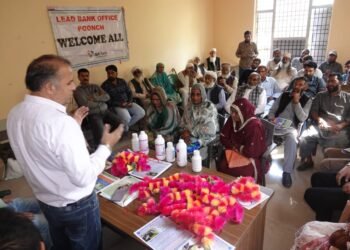
SKUAST-K’s Student Rural Exploration Program aims to build this connection by exposing students to village realities and encouraging them to understand local challenges before proposing solutions. According to university figures, more than 4,000 students have engaged with approximately 450 villages through this initiative.
The significance of such engagement goes beyond field exposure. It helps students appreciate that agricultural problems rarely occur in isolation. Productivity is linked to access to technology, input availability, climate variability, post-harvest management, markets, and rural households’ capacity to adopt new practices.
The university has also pursued approaches to bring agricultural guidance closer to farming communities, including developing a network of Kissan Khidmat Ghars and digital advisory mechanisms. The broader objective is to make scientific expertise more accessible and responsive to farmers’ needs.
This shift from the laboratory to the landscape changes the university’s relationship with society. Farmers are not merely recipients of technologies developed elsewhere; their experiences, constraints, and aspirations become inputs into the research and educational process itself.
Research shaping public policy: The HADP experience
One of the most consequential aspects of SKUAST-K’s recent engagement with Jammu and Kashmir’s development agenda has been its contribution to the conceptualization and technical design of the Holistic Agriculture Development Programme (HADP).
With an overall program outlay of approximately ₹5,013 crore, HADP comprises 29 projects designed to strengthen agriculture and allied sectors. Its approach extends beyond increasing primary production to include diversification, value addition, mechanization, entrepreneurship, post-harvest infrastructure, and stronger links with markets.
The program reflects an important development principle: agricultural growth must be understood as a connected economic system rather than a collection of isolated farm-level interventions.
For a region seeking to raise rural incomes and create meaningful employment, this requires coordination among research institutions, government departments, farmers, entrepreneurs and markets. The university’s contribution demonstrates how academic expertise can inform public programmes on a substantial scale.
The wider lesson is that universities can do more than evaluate policies after they have been introduced. When engaged early and systematically, they can contribute to the design of development strategies, provide technical knowledge and help connect policy objectives with scientific evidence.
The long-term measure of HADP will be its demonstrable impact on productivity, farm incomes, employment, enterprise creation and the resilience of rural households. Sustained assessment and evidence-based course correction will be essential to realise its full potential.
Preparing for Agriculture 4.0
Artificial intelligence, data analytics, robotics, precision technologies, biotechnology, and new approaches to managing natural resources are reshaping agriculture. Agricultural universities must therefore prepare students not only for existing professions but also for occupations and enterprises that are still emerging.
SKUAST-K has sought to respond through academic restructuring and the introduction of programmes linked to new technologies, including a B.Tech programme in Artificial Intelligence in Agriculture. The emphasis is on preparing graduates who can combine agricultural understanding with computational and analytical skills.
The university’s School of One Health similarly reflects an expanding understanding of scientific challenges. Human health, animal health and environmental health are closely interconnected, particularly in ecologically sensitive mountain regions. Research that brings these disciplines together can advance understanding of zoonotic diseases, antimicrobial resistance, food safety, and environmental change.
These initiatives suggest that the future of agricultural education lies in crossing disciplinary boundaries. The next generation of agricultural professionals will need to understand biology alongside data, farming systems alongside markets, and scientific discovery alongside its social and environmental implications.
Expanding opportunities and transforming the student landscape
One of the most visible indicators of SKUAST-K’s transformation has been the expansion of its academic programmes and the changing composition of its student community. Over the past five years, the university has expanded its undergraduate offerings from six to fourteen programmes, introducing new, market-oriented disciplines designed to respond to emerging employment opportunities, technological change and the evolving needs of agriculture and allied sectors.
This diversification has helped broaden the university’s appeal. Student enrolment has increased from approximately 2,100 in 2021 to nearly 5,900 in 2026. The growth represents more than an increase in numbers: it reflects a widening of educational opportunities and a growing interest in the university’s evolving academic portfolio.
Perhaps even more striking is the geographical diversity of its student body. In 2026, SKUAST-K has students representing every State and Union Territory of India, giving it the highest such representation among State Agricultural Universities in the country. This is a notable achievement for a university located in the Kashmir Valley and reflects its growing national reach and appeal.
A diverse student community brings more than demographic representation. It creates opportunities for cultural exchange, the sharing of ideas and experiences, and a richer academic environment. Students from different regions bring varied agricultural practices, social contexts and perspectives to the campus, strengthening the educational experience for the entire university community.
For SKUAST-K, this development also represents a broader connection between the Kashmir Himalayas and the rest of the country. The university is increasingly serving as a national academic destination while continuing to address the distinctive agricultural and ecological challenges of its home region.
Internationalizing education: From local roots to global connections
Alongside its expanding national footprint, SKUAST-K has made considerable progress in internationalizing education. Foreign student enrolment has risen from just two students in 2021 to 53 in 2026—a remarkable increase that reflects the university’s growing international engagement.
Internationalization, however, is not simply about attracting students from abroad. It also involves enabling domestic students and faculty to engage with international institutions, encounter different research cultures, and build lasting academic relationships.
Over the past five years, more SKUAST-K students have had opportunities to travel for academic exposure and international learning experiences in Europe, the United States, Australia, Japan, Taiwan, and other destinations. These outgoing opportunities, alongside the growing presence of international students on campus, are helping establish a more reciprocal model of academic engagement.
Such exchanges can broaden scientific perspectives, strengthen cross-cultural understanding and expose students to new approaches in research, technology and enterprise. They also help connect the university’s expertise in mountain agriculture, horticulture, animal sciences and other regionally significant disciplines with wider international knowledge networks.
The university’s international education initiatives and its emerging global roadmap, discussed at the level of the University Council, seek to build on this foundation. The ambition is to develop stronger international partnerships, expand collaborative research and position SKUAST-K as a recognized institution in areas where its regional strengths have global relevance.
Achieving this ambition will require sustained investment in research infrastructure, faculty development, student support and durable international partnerships. Global recognition is not achieved through declarations alone; it must be built through the quality of research, the relevance of education and the strength of institutional collaboration.
A university that is learning to do more with less
Institutional change is also visible in the everyday systems through which a university operates.
The adoption of digital examination processes, for example, has helped reduce dependence on paper. The university estimates that these measures save approximately 2.1 million sheets of paper annually. Beyond the environmental benefit, digital systems can improve administrative efficiency and create opportunities for more transparent and responsive institutional processes.
Such measures may appear modest beside major research programs or new academic schools, but they are part of the same larger objective: building a university that is more efficient, technology-enabled and conscious of its responsibilities.
The challenge ahead is to ensure that digitalisation is accompanied by strong systems for data security, accessibility, reliability and continuous improvement.
Leadership, institutional culture and the road ahead
Transformations of this nature do not occur through a single initiative or an individual intervention. They require institutional leadership, collective commitment, policy support and the sustained efforts of teachers, scientists, technical staff, administrators, students and external partners.
At SKUAST-K, the recent period has seen a concerted effort to align academic reforms, research, innovation and developmental engagement under a more ambitious institutional vision. Leadership has played an important role in setting this direction, encouraging experimentation and creating space for initiatives that extend beyond conventional university functions. The larger achievement, however, lies in how fully these changes become embedded in the university’s systems and culture.
As SKUAST-K looks towards its next phase of development, the task is to consolidate what has been initiated. Startups must become sustainable enterprises. Research outputs must translate into technologies and measurable benefits. Agricultural development programmes must demonstrate lasting improvements in livelihoods. Academic reforms must produce graduates equipped for a changing world. And international aspirations must be supported by globally competitive research and durable partnerships.
Continuity of purpose, institutional memory and sustained implementation will be important in this phase. The challenge is not merely to launch new initiatives, but to ensure that they mature, deliver results and become enduring institutional strengths.
The real measure of a public university
The experience of SKUAST-K offers a wider lesson for public higher education in India. Universities need academic freedom and scholarly depth, but they must also remain connected to the realities of the societies that sustain them.
Their contribution should be measured not only by publications, degrees and rankings, but also by the quality of their graduates, the usefulness of their research, the enterprises they help create, the public policies they inform and the lives they improve.
For an agricultural university in the Kashmir Himalayas, this responsibility is particularly clear. Its success must ultimately be reflected in stronger farming systems, more resilient rural livelihoods, new opportunities for young people and better stewardship of the region’s natural resources.
The transformation of SKUAST-K is an evolving process, not a finished story. Its next chapter will depend on how effectively the institution consolidates its reforms, strengthens its scientific foundations and sustains its engagement with society.
The most important lesson from Shalimar may therefore be a simple one: a university fulfils its promise when knowledge does not remain confined to the campus, but becomes a force for progress beyond its gates.